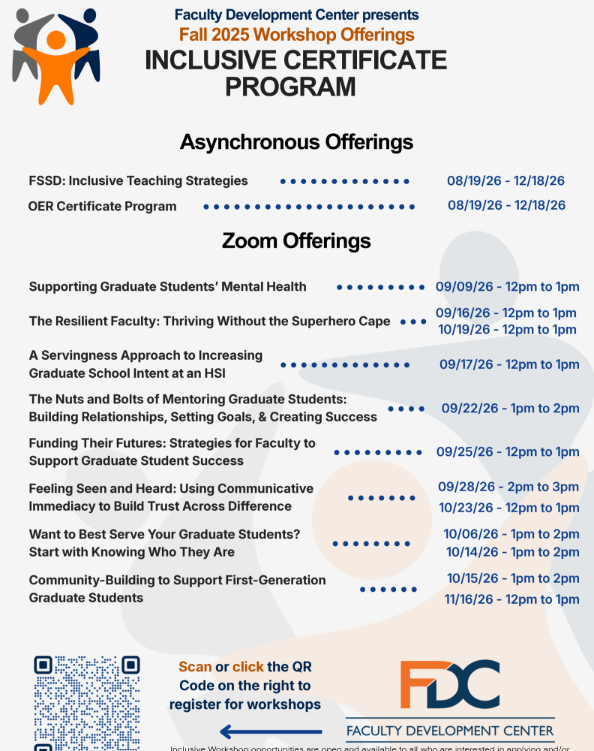
Fall 2026 Offerings
To register for any of the workshops below please use the INCLUSIVE registration form.
Supporting Graduate Students’ Mental Health
Facilitated by Dr. Adrian A. Rodriguez
- Wednesday, September 9, 2026 | 12:00pm-1:00pm (Zoom)opens in a new window
This workshop explores how faculty can support graduate students' mental health by considering intersectionality, resilience, discrimination, microaggressions, and imposter syndrome. Attendees will develop strategies to broach mental health topics, cultivate empowering academic environments, and promote a culture of well-being and cultural responsiveness in their departments.
The Resilient Faculty: Thriving Without the Superhero Cape
Facilitated by Dr. Jason Branch
- Wednesday, September 16, 2026 | 12:00pm-1:00pm (Zoom)
-
opens in a new windowMonMMonday, October 19, 2026 | 12:00pm-1:00pm (Zoom)
Are you wearing the superhero cape but running on empty? This workshop is designed to help faculty prioritize their own well-being while continuing to support their students effectively. Explore practical self-care strategies and learn how to build healthy systems, routines, and boundaries with graduate students. Leave with actionable tools and fresh ideas to foster resilience and sustainability in your academic life.
A Servingness Approach to Increasing Graduate School Intent at an HSI
Facilitated by Dr. Adrian A. Rodriguez
- Thursday, September 17, 2026 | 12:00pm-1:00pm (Zoom)opens in a new window
This workshop reviews research on servingness, community cultural wealth, and Latiné resilience to increase graduate school intent, especially for Latiné and first-generation college students. Participants will explore culturally sustaining practices that introduce graduate experiences, build self-reassurance, reduce academic stress, and strengthen support networks aligned with CSUF’s commitment to servingness. The session blends data-driven insights with interactive discussion and practical strategies to promote belonging and demystify graduate school.
The Nuts and Bolts of Mentoring Graduate Students: Building Relationships, Setting Goals, & Creating Success
Facilitated by Dr. Matt Englar-Carlson
- Tuesday, September 29, 2026 | 1:00pm-2:00pm (Zoom)opens in a new window
Effective mentoring of graduate students of color is not mentoring as usual. It requires culturally responsive attention to the multiple identities and lived experiences of the mentee. This workshop explores evidence-based mentoring practices that focus on nurturing the relationship between mentor and mentee. Cultivating belonging and mattering, addressing overcoming barriers in higher education, and setting reasonable and reachable goals are the building blocks of graduate student success. Attendees will reflect upon their mentoring style, develop practical strategies for communicating with mentees, and gain an understanding of realistic ways to be an effective mentor.
Funding Their Futures: Strategies for Faculty to Support Graduate Student Success
Facilitated by Dr. Matt Englar-Carlson
- Friday, September 25, 2026 | 12:00pm-1:00pm (Zoom)opens in a new window
Graduate school funding and financial support is often a challenging labyrinth for graduate students and faculty. Recent changes in federal loans by the Department of Education makes this even more challenging. This workshop equips faculty with actionable strategies to connect students with scholarships, funding, and travel opportunities—both on campus and beyond. Learn how to identify hidden pockets of support, guide students through the application process, and empower first-generation and underrepresented graduate students to leverage their cultural strengths and talents. Participants will leave with practical tools, fresh ideas, and a roadmap to foster graduate student success in a resourceful and impactful way.
Feeling Seen and Heard: Using Communicative Immediacy to Build Trust Across Difference
Facilitated by Dr. Erika Thomas
- Friday, September 28, 2026 | 2:00pm-3:00pm (Zoom)
- Friday, October 23, 2026 | 12:00pm-1:00pm (Zoom)
This workshop explores how immediacy behaviors, e.g. verbal strategies, accessibility cues, and forms of nonverbal engagement, can counteract uncertainty, distancing, and difference and, instead, foster an environment where mentees of diverse backgrounds feel empowered and connected. Participants will examine and consider how interpersonal and intercultural communication tools can foster trust, navigate misunderstandings, and result in growth and support for mentees (and mentors).
Want to Best Serve Your Graduate Students? Start with Knowing Who They Are
Facilitated by Dr. Volker Janssen
- Thursday, October 6, 2026 | 1:00pm-2:00pm (Zoom)
- Wednesday, October 14, 2026 | 12:00pm-1:30pm (Zoom)
Our campus serves almost 5000 graduate students, but our campus-wide conversations rarely focus on their stories and background. CSUF graduate students are unique, and assumptions about undergraduates rarely translate to graduate student cohorts. This practical workshop draws on CSUF data to illustrates the uniqueness of our graduate students and provide clear insights about how to meet your students where they actually are.
Community-Building to Support First-Generation Graduate Students
Facilitated by Dr. Edson Andrade
- Thursday, October 15, 2026 | 1:00pm-2:00pm (Zoom)
- Monday, November 16, 2026 | 12:00pm-1:00pm (Zoom)
Community is a powerful driver of graduate student success—especially for first-generation students navigating unfamiliar expectations and “hidden curriculum.” In this session, participants will explore concrete, culturally responsive ways to build connection, normalize help-seeking, and create learning and mentoring environments where first-generation graduate students can thrive.
The Art of Classroom Dialogue: Creating Space for Critical Thinking and Difficult Conversations
Facilitated by Dr. Ella Ben Hagai, Department of Psychology
- Tuesday, November 3, 2026 | 12:00 pm - 1:15 pm (Zoom)
- Tuesday, November 10, 2026 | 12:00 pm - 1:15 pm (In-Person)
Since Socrates, dialogue has been one of the most powerful ways to foster learning, critical thinking, and identity exploration in higher education. Today, however, screen culture, social isolation, and political polarization have made it increasingly difficult to engage students in meaningful classroom dialogue, especially when the conversation turns to controversial issues.
This workshop offers an overview of effective methods for creating student-centered, generative dialogue in the classroom. Beyond introducing a range of approaches to constructive discussion, we will explore how to build safe spaces for difficult conversations, where students feel free to bring their whole selves into the classroom. We will also examine best practices for navigating classroom conflict and discuss ways to transform it from a disruptive force into a productive one that sparks inquiry and deeper understanding.
FSSD: Inclusive Teaching Strategies
Facilitated by Shelli Wynants
Introduction to three inclusive strategies you can easily implement into any course modality or discipline; you can track equity gaps over time using Faculty Student Success Dashboard (FSSD). This online course can be completed in about one hour!
OER Certificate Program
Facilitated by Claudia Acosta
The Open Educational Resources (OER) Certificate Program is an innovative, self-paced online course designed to empower instructors with the knowledge and skills needed to integrate free, high-quality educational materials into their curriculum. This comprehensive program guides faculty through the process of searching, evaluating, and implementing OER, while also covering essential topics such as Copyright, Creative Commons licensing, and Affordable Learning Solutions. Through a series of asynchronous, sequential modules, participants will engage in instructional content, self-reflection exercises, and practical application activities. The course, which takes approximately 3-5 hours to complete, offers a deep dive into adopting, adapting, and creating OER materials, as well as licensing and publishing original work.
-
Outcomes: After taking this course, participants will be able to define Open Educational Resources (OER) and explain their uses and benefits for college affordability and student success; distinguish among Copyright, Fair Use, Public Domain, and Creative Commons licenses to apply them appropriately to educational materials; identify and evaluate alternatives to traditional textbooks, with practical guidance for OER adoption; discover, adapt, and accurately attribute OER resources for instructional use; explain how the Affordable Learning Solutions (AL$) program supports the shift to free or low-cost materials for students; and assess the impact of OER and AL$ initiatives on educational access, retention, and learning outcomes.