

How to Spot AI-Generated Writing
Review the infographic, How to Spot AI-Generated Writing, for additional considerations when evaluating a student submission.
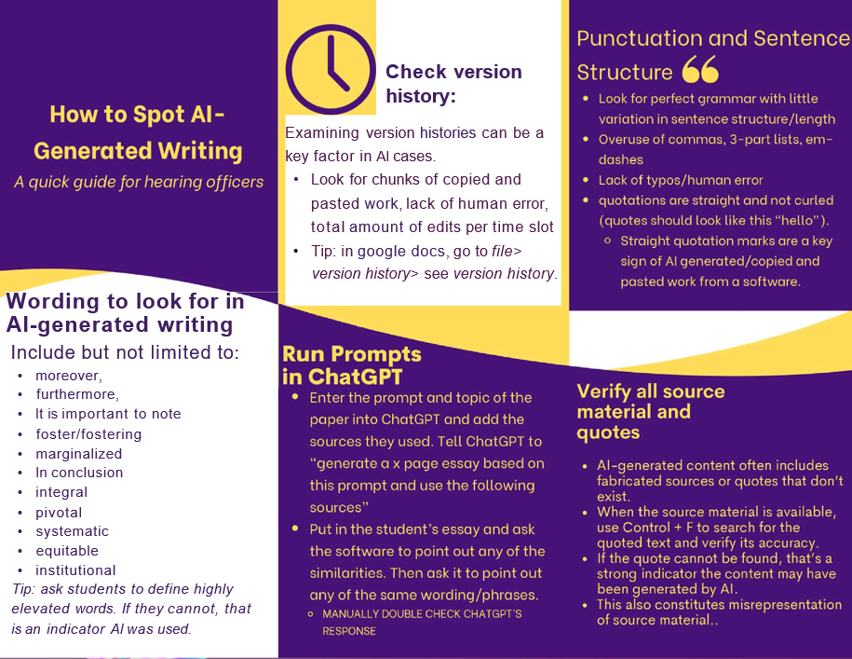
Source: Wyatt, 2026 (ASCA Conference).
Check Version History
Examining version histories can be a key factor in AI cases.
- Look for chunks of copied and pasted work, lack of human error, total amount of edits per time slot
Tip: in google docs, go to file> version history> see version history.
Punctuation and Sentence Structure
-
Look for perfect grammar with little variation in sentence structure/length
-
Overuse of commas, 3-part lists, em-dashes
-
Lack of typos/human error
-
quotations are straight and not curled (quotes should look like this “hello”).
-
Straight quotation marks are a key sign of AI generated/copied and pasted work from a software.
-
Wording to Look for in AI-Generated Writing
Include but not limited to:
-
moreover,
-
furthermore,
-
It is important to note
-
foster/fostering
-
marginalized
-
In conclusion
-
integral
-
pivotal
-
systematic
-
equitable
-
institutional
Tip: ask students to define highly elevated words. If they cannot, that is an indicator AI was used.
Run Prompts in ChatGPT
-
Enter the prompt and topic of the paper into ChatGPT and add the sources they used. Tell ChatGPT to “generate an X page essay based on this prompt and use the following sources”
-
Put in the student’s essay and ask the software to point out any of the similarities. Then ask it to point out any of the same wording/phrases.
-
MANUALLY DOUBLE CHECK CHATGPT’S RESPONSE
-
Verify All Source Material and Quotes
-
AI-generated content often includes fabricated sources or quotes that don’t exist.
-
When the source material is available, use Control + F to search for the quoted text and verify its accuracy.
-
If the quote cannot be found, that’s a strong indicator the content may have been generated by AI.
-
This also constitutes misrepresentation of source material.
Questions About the Submission to Consider
-
What is it about the written submission, other than an AI detection program score, that leads you to conclude that it is not the student’s own work?
-
Is the work grammatically perfect, no spelling errors but substantively broad, vague and not on point, no specifics or references to class material or examples?
-
Is the information factually true and valid or is there fabricated content, made up facts and sources? (eg. characters or incidents that don’t exist in the story, movie, song etc.)
-
Does the suspicious submission fail to align with the students “in-class” or other written work? Is this essay written in a different “voice” than the student’s other work?
-
Are the suspicious submissions different in tone, or level of sophistication and expression from the student’s previous responses?
-
Are there significant differences in the vocabulary, grammar, sentence structure etc. in this submission versus the student’s previous work?
-
Were the responses the student submitted similar in form and content to results generated when you submitted the same prompt to ChatGPT or other generative AI program?
-
Was the student unable to explain key concepts, vocabulary, analysis or other elements of the work they submitted? (If so, that fact alone could suffice to establish our “preponderance of the evidence.”)
-
Check the citations in the submission. Are they valid? false/fabricated?
-
Are there changes in voices (that would suggest that the student had imbedded AI or other non-original material into something they had written in part)?
-
Are there errors in reasoning and analysis?
Examples of Faculty Notes in Reports
-
“The student submitted an essay with no incremental development, and it was very similar in examples and turn of phrase to two other suspicious essays, which were very similar to an essay ChatGPT generated for me in response to my exam prompt.”
-
“Some student papers were discussing the same character that didn’t exist in the film.” Faculty detected a pattern of an AI generating tool generating the same misinformation/false information, phrased the same way.
-
Faculty detected similar phrasing over and over again in several student papers.
-
“They are using AI paraphrasing tools that paraphrase into something that doesn’t make sense.” Example: The film title, “Who Killed Vincent Chin” appeared in the student’s paper as, “Who Killed Vincent Jaw?” and the film title, “The Good Earth,” became, “The Great Soil.”
-
“On exam of short answers, the student’s responses where like what I ‘d expect and have seen from students, but then the last response was a long and sweeping discussion unlike all the other answers the student provided. It stuck out as very different.”
-
“I entered the question prompt into ChatGPT and got an answer nearly identical to what the student submitted, structure, format, progression of ideas, concepts etc..”
-
“The student didn’t recall much about the paper and couldn’t explain terms or vocabulary used.”
Steps for Suspected Academic Dishonesty
Refer to UPS 300.021 for Academic Integrity
-
Notify the student of the concern and offer to meet with the student.
-
If the preponderance of the evidence leads you to conclude the student violated academic integrity standards, assign an appropriate grade sanction.
-
Send your report to the Office of Student Conduct.
-
** The student has the right to appeal the faculty grade determination through the Academic Appeals process. (UPS 300.030)
Incident Reporting and Resources
If you are reporting potential unauthorized use of artificial intelligence, please include:
-
The assignment or exam;
-
Course syllabus with assignment/exam instructions and your written policy on unauthorized AI use;
-
A description of the work and specific aspects of the submission that appear inconsistent, unusual, or concerning, based on your expertise and familiarity with the student’s prior work or course expectations;
-
Reports should be grounded in observable characteristics of the work; artificial intelligence detection reports alone are not sufficient to support a referral.
-
How to Report (When Reporting an act of academic dishonesty, please see UPS 300.021)
-
Discuss the matter with the student involved. If you determine that academic dishonesty has occurred, then assign an appropriate grade sanction and notify the student of your decision.
-
If circumstances prevent consultation with the student, you may still assign a grade sanction.
-
Submit an online Academic Dishonesty Referral form to Student Conduct. In completing the referral form, copy your Department Chairperson and submit the form along with any supporting documentation to Student Conduct, preferably within 15 calendar days from discovery, but no later than 30 calendar days after the first day of classes of the regular semester following the grade assignment.
Common Faculty Questions
-
What should I do if Disability Support Services tells me my student was cheating while DSS was administering their exam?
- Meet and discuss with the student that you will be submitting an incident report and assigning a grade assessment. Send your report to Student Conduct even if you believe DSS submitted a report.
-
Do I wait to hear from Student Conduct before I determine a grade sanction?
- No. The faculty member determines the grade before submitting the incident report to the Office of Student Conduct. The Office of Student Conduct will not modify the assigned grade sanction.
-
Grades are due, but I suspect the student used unauthorized Artificial Intelligence on the final exam. What should I do?
- Faculty may assign an “RP” or comparable placeholder if called upon to submit grades before they can meet with the student and determine whether there is a suspected violation of academic integrity. Check in with your Department Chair on the department’s grade submission process.
-
A student wants to appeal, but they have not met with Student Conduct. Should I meet with the student?
- Yes. The student can submit an appeal to the Academic Appeals Board prior to meeting with Student Conduct. A meeting and discussion with the faculty is also a step in the Academic Appeals process.
-
What if a student asks me to sign a withdrawal form after I have notified them about academic dishonesty?
- You should review the course withdrawal policy and consult with the department chair before approving/signing the withdrawal form. Meet with the student to verify the student’s circumstances. It is important that you save the student’s work in Canvas before approving the withdrawal. A grade sanction cannot be assessed and assigned once the student has been officially withdrawn from the course and received a “W” grade.
-
May I assign a grade penalty for a behavioral matter?
- No. Grade assessments are assigned exclusively for academic integrity violations.
-
I caught a student cheating on an exam. Can I prevent them from returning to class?
- No. The only penalty that faculty may assign for an academic violation is a grade penalty.
-
Will I be provided updates or told the outcome of a case?
-
Student conduct records are protected by the Family Educational Rights and Privacy Act (FERPA). Please understand that the Office of Student Conduct may not share information about a student’s conduct case with you unless it falls within an exception to FERPA privacy restrictions. We review and take appropriate administrative action on every report received. Your Maxient email acknowledgment is your confirmation that the report has been received and will be acted upon as appropriate.
-